¡Mira lo que hago!
Durii Editorial · Cuentos de 4 a 8 años · Infantil y Juvenil · Todas las edades
Synopsis
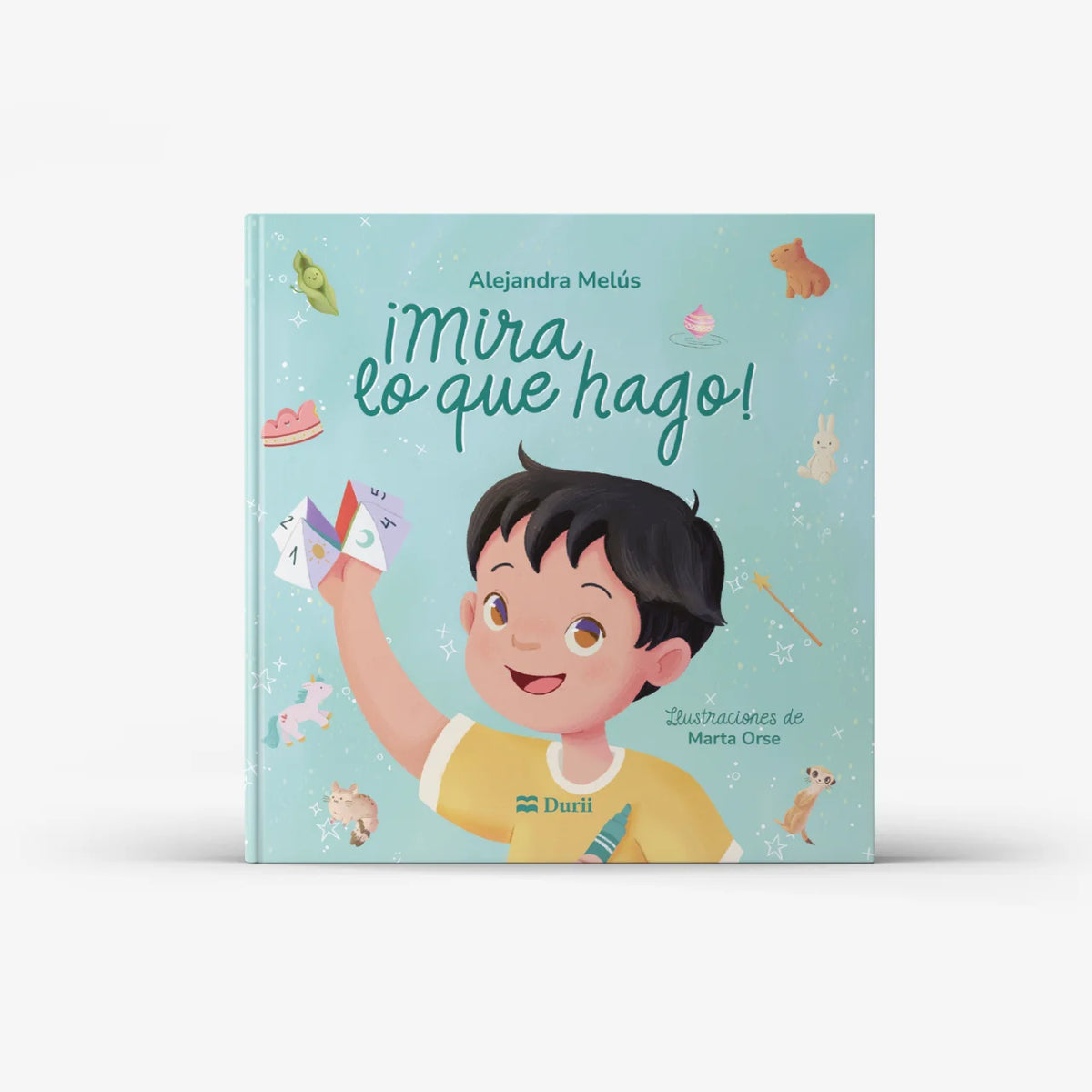
The holidays have arrived, but Mum and Dad are not quite free yet. Álex learned to make a paper fortune teller at camp and is desperate to show his family: it is his way of saying look what I can do, look what I'm capable of. But Mum is jotting down something for work while he talks, takes a call for a meeting and drifts away before he reaches the end of his sentence. When Álex looks for his older sister Olivia, she would rather play with her costumes: she's too grown-up for those games now. He feels completely alone, even though he is surrounded by people who love him.
At dinner that evening, the adults cut the children's camp stories short because it's getting late. And in bed, during their nightly ritual of reaching across until their hands meet and sharing the best and worst of the day, Álex confesses what has really hurt: not having played with anyone, not having been able to show off his fortune teller. Olivia, who was going to talk about her cabin, is left waiting when her brother cannot find a clear answer to and the best part?
What the children don't know is that Mum and Dad have heard them, as they do every night, when they look in to say goodnight. And they decide something has to change. The next morning they come singing into the bedrooms with a surprise: instead of the usual routine, today means the pool — but properly this time, with the parents in the water too. Dad jumps in first to a chorus of laughter, Mum does a cannonball — something the children have never seen her do — and the four of them end up competing to show each other somersaults, jumps and different ways to dive.
Out of that recovered closeness, Mum has an idea: invent a secret word the family can use whenever they need to feel connected. Amid laughter and outlandish suggestions — «edamame», «capibara», «gamusino» — they finally settle on «suricata», chosen by Dad because meerkats always stay together, look after one another, and every member of the colony matters and is needed. That night, the four of them fall asleep together, hands joined, knowing they have lived, wide awake, the best dream of their lives.
¡Mira lo que hago! closes with a note for parents and educators on the sense of belonging, secure attachment and the importance of present, attentive parenting in everyday life, written by Alejandra Melús drawing on more than fifteen years of working alongside families.
Machine translation, pending review.
Selling points
- Escrito por una experta en atención temprana con más de 15 años de consulta directa con familias
- Incluye una guía divulgativa final para padres y educadores, no solo el cuento
- Aborda la conciliación laboral-familiar, un tema poco tratado en álbum ilustrado español
- Ritual replicable: la palabra secreta familiar como recurso práctico inmediato
- Autora con plataforma mediática activa (El País, Onda Cero, Club de Malasmadres)
- Doble lectura: entretiene al niño y interpela suavemente al adulto que lee en voz alta
Comparable titles
- El monstruo de colores, Anna Llenas
- Adivina cuánto te quiero, Sam McBratney
- El cazo de Lorenzo, Isabelle Carrier
Technical data
- ISBN
- 978-84-10075-69-6
- Format
- Hardcover
- Pages
- 36
- Dimensions
- 210 × 210 mm
- Weight
- 334 g
- RRP
- €18.00 (VAT included)
- Publication
- 14 May 2026
- Edition
- Edition 1
- Legal deposit
- M-10940-2026
- Language
- es
- Imprint
- Durii Editorial
- Series
- Cuentos de 4 a 8 años
- Age
- Todas las edades
Classification
Cuento sobre familia y vínculos afectivos · Cuento emocional con función pedagógica · Cuento realista de vida cotidiana
For bookshops and distributors
The price shown includes VAT. Trade terms and orders are in the
Distribution: Azeta in Spain · Panoplia de Libros in Latin America · Direct distribution from the publisher
Rights
Translation rights available for all languages.
«¡Mira lo que hago!» is a warm picture book by Alejandra Melús, a Spanish child-development expert with fifteen years of clinical experience and an active media presence (El País, national radio, parenting platforms). The story follows siblings Álex and Olivia through an ordinary summer holiday: their working parents are physically present but emotionally distracted, and the children's small bids for attention go unnoticed until a nighttime bedtime ritual reveals their quiet frustration. The resolution arrives through play, not lecture — a spontaneous pool day where the family invents a secret code word, 'suricata' (meerkat), as a lasting symbol of belonging and mutual care. The book closes with a practical afterword for parents and educators on secure attachment and the sense of belonging, making it equally valuable as a read-aloud story and as a parenting resource. Its themes — work-life balance, attentive presence, sibling connection — are universally recognizable across markets grappling with dual-income parenting pressures, positioning it well alongside international attachment-focused picture books for ages 4 to 8.

Alejandra Melús
Madrid · 1986
I am an expert in early intervention, early childhood and emotional intelligence. Mother of a girl and two boys, whom I adore and who are the driving force of my life. For more than 15 years I have been supporting children and their families through personalised, one-to-one consultations and sessions in which we address the child's developmental progress across all areas, working to meet the needs of both the child and their family. I am also a popular educator in the fields of education and childhood through my social media @melusalejandra on Instagram, and through the talks and workshops I run at schools, nurseries, companies and local councils. I contribute to various media outlets, writing articles for Club de Malasmadres, the newspaper El País, the Penguin Kids digital magazine and the educational platform Save Family. I have my own regular slot on Onda Cero called «Acompañando», where I enjoy walking alongside families to guide them through the fascinating world of raising, educating and nurturing their children.
Machine translation, pending review.